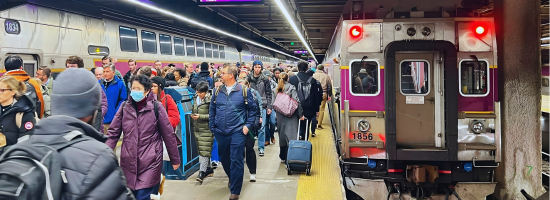
Last month, the MassINC Policy Center and TransitMatters released a study on Harnessing the Full Potential of Regional Rail. The report shows how the MBTA’s initial steps to transform commuter rail into a modern Regional Rail system are already delivering tangible benefits to Gateway Cities. It also identifies several straightforward actions to further increase ridership. The massive, multi-year operating contract that is now out for bid presents a prime opportunity to move this agenda forward.
Over the past five years, the MBTA has made significant progress toward a Regional Rail operating model. It has significantly improved service frequency by spreading the schedule out. Passengers traveling in the middle of the day no longer encounter lengthy gaps between trains. With more frequency throughout the day, the commuter rail now operates on a predictable “clock face” schedule. This makes it easier for passengers to remember departures without referring to timetables, and it also helps integrate commuter rail with other transit services to facilitate transfers. To make train travel more affordable, the MBTA created a $10 Weekend Pass and the Income-Eligible Reduced Fare program.
Evidence suggests these changes are already increasing ridership in a manner that will lead to more balanced and equitable economic growth. Between 2018 and 2024, reverse commuters traveling to Gateway Cities increased 23 percent on average. The ratio of morning riders leaving Gateway Cities to those arriving from Boston has improved from 10-to-1 to 5-to-1. Regional Rail is also starting to function more like a true network with multiple nodes along each line, rather than a hub-and-spoke system with Boston as the main origin and destination. On average, interzone travel to Gateway Cities has increased by 37 percent.
Passenger survey data show how these changes are increasing economic opportunity and quality of life for low- and moderate-income residents. Prior to the Regional Rail modifications, low-income riders made up just 7 percent of commuter rail passengers. Now they account for over one-third of those utilizing these trains. Two-thirds of riders now walk or bike to stations, up from about half before Regional Rail policies took effect. This promising pattern suggests Regional Rail investments will increase the appeal of living near stations, making more complex Gateway City transit-oriented development projects economically viable in the future.
Our report encourages the MBTA to build on the gains it has made in the near-term by reducing off-peak and reverse-commute fares by half—providing deeper discounts to low-income riders, and partnering with property owners to find creative strategies to further increase transit use in developments near station areas.
The commuter rail operating contract competition currently underway is a pivotal opportunity to make even greater progress on Regional Rail; all signs suggest that the MBTA is working hard to seize it. With the current contract expiring in June 2027, the agency recently shortlisted three bidders, each with cutting-edge expertise from Europe and other advanced transit markets. The MBTA has explicitly prioritized proposals to transform the legacy commuter rail system into a modern, high-frequency Regional Rail service. This language gives the private companies seeking the contract powerful incentives to put forward innovative solutions.
The MassINC-TransitMatters analysis reveals trains currently operate at just 13 percent capacity during off-peak periods and 8 percent in reverse direction during rush hours. Strong proposals will include valid strategies to fill more of these empty seats by furthering Gateway City economic development.
Get the latest updates on policy issues impacting Gateways Cities delivered right to your inbox.
The Gateway Cities Innovation Institute strengthens connections across communities and helps Gateway City leaders advance a shared policy agenda.