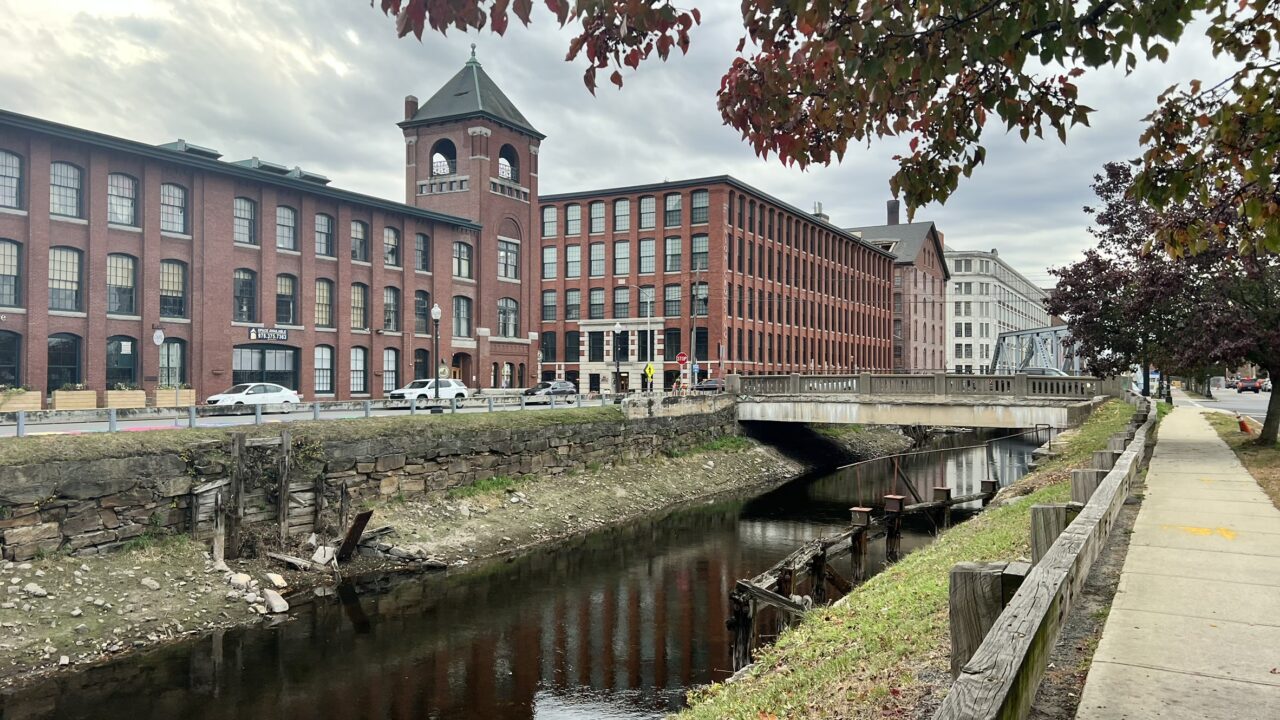
MassINC coined the term “Gateway City” in 2007 to describe a small group of cities shaped by a wave of deindustrialization but still possessing the density, infrastructure, and location to drive regional economic growth beyond Greater Boston. A lot of time has since passed, and the term has begun to take on a life of its own. With a growing number of communities angling for the official state designation, it’s worth reflecting on the original impetus, and what we’ve learned about targeted regional economic development as this effort has evolved.
Old time MassINCers will tell you that the seed for the Gateway Cities Initiative was planted in 1998, when one of our very first research reports asked: “Can the Commonwealth truly prosper if only one region is flourishing?” Drawing on the experience of five former Massachusetts secretaries of economic development, the authors concluded that the answer was no.
A few years later, MassINC partnered with the Brookings Institution to develop a strategy to help regions beyond I-495 find their footholds in the New Economy. The report was released just as Gov. Patrick took office. Reconnecting Massachusetts Gateway Cities wasn’t about labeling struggling places, but rather demonstrating the untapped economic assets and latent potential of our former mill cities.
The 11 Gateway Cities identified in the report were not selected at random, and they were certainly not included simply because they faced challenges. They historically served as regional urban job hubs, and we believed that their assets, in terms of infrastructure, manufacturing know-how, abundant housing, walkability, density, colleges, hospitals, downtowns, services, and relatively young and diverse populations, continued to position them as future economic engines that could benefit all of their surrounding communities.
Gateway City legislators understood how much more their communities could contribute even as the state’s economic policies remained Boston-centric. They formed a caucus in 2008 and quickly filed legislation to codify the term in law. To identify Gateway Cities, they sought a small set of clear, objective, and easy-to-understand measures, settling on the following three:
- Population between 35,000 and 250,000;
- A median income lower than the state’s; and
- College education rates lower than the state median.
Over time, we have come to see that this quantitative approach emphasizes deficits rather than assets. It also resulted in a larger list of 26 Gateway municipalities. And almost immediately, there were efforts in the legislature to revise the formula and expand the group even further (see Commonwealth’s 2012 article: The latest trend: Being a Gateway City).
Entering a period of resource scarcity, there will likely be more attempts to alter the Gateway Cities definition or otherwise shift the balance of funding across communities. This session, State Senator Bill Driscoll filed S. 297, An Act Relative to Gateway Municipalities, which would add two new criteria—a “minority population of 40 percent or higher, and 15 percent or more of households identify as speaking English less than ‘very well;’” qualifying communities would only need to meet three of the five measures. The Secretary of Economic Development would be responsible for certifying communities every 10 years after the census.
Sen. Driscoll represents the Town of Randolph, a suburban community on the South Shore that has experienced rapid demographic change, including a burgeoning community of African-American homeowners. Randolph has pointed out that it should meet the Gateway City definition, but its suburban character, absence of a regional urban center, and lack of a history of de-industrialization also makes it quite different to the other Gateway Cities.
As these debates play out on Beacon Hill, several foundational questions are worth contemplating.
1. What is the benefit of being a Gateway City?
Ostensibly, Gateway City municipality designation provides additional access to state resources. Some state funds, like the Housing Development Incentive Program, are available only to Gateway Cities. Other programs have set asides that reserve a portion of the funds for Gateway Cities. Nobody has been able to keep track of all the different programs, both public and private, targeted to Gateways Cities. It would be even more difficult to count how much money has been allocated to Gateway Cities through these various programs. And honest accounting would net out public and private investment that would have otherwise flowed to these communities in the absence of the state designation.
Many observers believe the initiative has been moderately successful at shifting state investment to these places, although imbalances certainly remain. As the MassINC Policy Center noted in a study last year, the state has invested excruciatingly little in the Pioneer Valley, and the consequences (and opportunity costs) are mounting as a result.
One of the clearest successes of the Gateway City concept has been the professional community that formed around it. Skilled practitioners in planning, housing, business development, and civic leadership have coalesced into a statewide network, strengthening one another’s work and accelerating progress across multiple cities. The shared identity has helped highlight opportunities and align strategies, which in turn has begun to attract investors looking for places with coordinated local leadership.
2. What do we gain, and what do we lose, with the current definition?
The current definition of a Gateway City has undeniable appeal. It is clear, numeric, and reproducible. With a few standardized metrics—population, income, and educational attainment—we can draw a bright line that tells us who belongs. That clarity simplifies data collection, makes program eligibility predictable, and transforms a handful of cities into a sizable coalition. It also spares legislators the uncomfortable work of choosing which cities have the potential to serve as regional anchors. Neutral-seeming criteria let the state sidestep value judgments.
Yet simplicity comes at a price. As the criteria shifted toward socioeconomic indicators, the designation drifted from its original strategic purpose and became more of a shorthand for high-poverty areas. That framing isn’t without benefits—it can unlock funding streams and attract well-intentioned advocates who want to support disadvantaged communities. But leaning too heavily on a deficit narrative carries its own risks. When the story that circulates is one of hardship rather than potential, it narrows how these cities are perceived and what others believe they can become.
Perhaps most problematic of all, the cold, hard, deficit-based formula has invited the suggestion that some revitalizing communities should “graduate” from being a Gateway City. When have you ever heard that Boston no longer requires specialized support and attention to continue performing its outsized regional economic functions?
One benefit of the current definition is that it expanded the tent. It pulled in regional hubs the original report arguably should have included—such as Lynn and Salem, both genuine economic anchors for the North Shore. And in politics, numbers matter: 26 municipalities speaking together command more attention than 11. But what you gain in scale, you can lose in identity. The original framework was intentionally selective, focused on midsize cities with colleges, hospitals, ports, and other major infrastructure that give them shared challenges and common ambitions. As the list broadens to include places without these features, the sense of shared purpose that has been one of the movement’s greatest strengths becomes harder to sustain.
3. When should investment be targeted geographically, and how?
Gateway Cities were originally conceived as a place-based strategy. But some problems—poverty, childcare costs, student debt, health disparities—follow people more than places. When we treat municipalities as proxies for populations, we risk overlooking vulnerable residents who live outside designated boundaries.
When a problem is rooted in geography, that doesn’t mean programs must be restricted to certain types of places. Some investments—broadband, climate resilience, technical assistance for zoning or planning—are better delivered universally. Any municipality can struggle with capacity, and universal access helps address need where it exists.
When we do limit eligibility, the targeting should align with the underlying problem. A program designed to expand homeownership production, for example, belongs in communities where ownership opportunities are scarce and rental housing dominates, not simply where poverty is high. Otherwise, resources drift toward places where need is assumed rather than demonstrated.
In Gateway Cities, the underlying problem is not simply concentrated poverty—it is the loss of their role as regional job centers. The challenge today is not only to support their residents, but to help these places find new industrial specializations capable of anchoring their regions in a modern economy. That requires aligning solutions with the geographic realities of where industries cluster, where infrastructure already exists, and where new economic activity has the best chance of taking hold. That’s why MassDevelopment’s Transformative Development Initiative is appropriately targeted to Gateway Cities as regional urban centers.
And that logic points to the larger truth: for the kind of change Gateway Cities need, small, scattered investments will not suffice. Structural barriers—historic disinvestment, aging infrastructure, entrenched path dependency—cannot be nudged loose with thinly spread dollars. They require concentrations of effort capable of breaking inertia and setting a new course. The question, then, is not just where we invest, but whether we are willing to invest at a scale that builds the critical mass necessary to set a new course.
While the precise answers to these three questions are not easy and total consensus could be elusive, there is one thing that remains as true today as it did when we published our first report in 2007. The Commonwealth benefits from a well-targeted place-based Gateway City strategy that supports core communities whose success will have a broader regional impact. Massachusetts needs to cultivate the next generation of regional urban centers with thriving neighborhoods, services, and jobs outside of Boston in order to achieve a more equitable, sustainable, and climate-friendly future for all our residents.
Get the latest updates on policy issues impacting Gateways Cities delivered right to your inbox.
The Gateway Cities Innovation Institute strengthens connections across communities and helps Gateway City leaders advance a shared policy agenda.