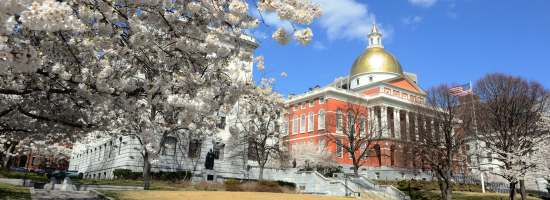
Like opening day at Fenway, Early College Day at the Massachusetts State House has become a rite of spring. This year’s gathering marked a turning point, both in appearance and in substance.
Let’s start with the optics of the day: The momentum that Early College has been building was clear from the size of the crowd assembled on March 25th. The group has already outgrown several venues at the State House. Now the 400+ attendees fill the Hall of Flags, the largest gathering space that the historic building has to offer.
Now on to the substance: Gateway City students and educators didn’t travel from every corner of the state just to be seen. They were there to encourage Beacon Hill leaders to keep improving and expanding access to Early College. Two important announcements proved that the journey was worth the effort.
The first bit of good news came from Pedro Martinez, the new Commissioner of Elementary and Secondary Education. In remarks to the group, he committed to producing a clear, and actionable strategy to scale Early College to 100,000 students. This goal represents dramatic expansion from current levels and reflects growing recognition that Early College remains one of the most effective tools available to improve postsecondary access and success—particularly for students who have been historically underrepresented in higher education.
Commissioner Martinez has been pushing educators to work toward 100,000 students since he first arrived in Massachusetts. Gov. Healey endorsed this goal in her state of the state address. With a solid strategy, we believe that the Commonwealth can move rapidly from modest incremental growth school-by-school toward a statewide system that provides high quality Early College options to all students.
The second breakthrough of the day came from Higher Education Commissioner Noe Ortega. He announced that the Department of Higher Education will, for the first time, hire a full-time Early College director (see here for the job posting, a Gateway City leader could excel in this role). Adding this new position at a time when the Commonwealth is doing very little hiring is equally consequential. In a state where higher education leadership is decentralized and often times fragmented, the department needs capacity and executive leadership to align institutions and their independent governing boards.
Together, these announcements build directly on the Early College expansion report that the MassINC Policy Center published last spring. That analysis demonstrated how Massachusetts could move from a collection of promising programs to a more intentional, system-level framework capable of reaching far more students. It emphasized the need for clear statewide goals, stronger coordination between K–12 and higher education, and dedicated capacity within state agencies to support implementation. The commitments announced at State House Day reflect meaningful progress on each of these fronts: a bold participation target, a clearer roadmap for expansion, and new institutional infrastructure to carry out the work.
Early College Day 2026 made clear that Massachusetts is entering a new chapter. The combination of ambitious scale and stronger capacity positions the Commonwealth to deliver on the promise of Early College—not just as an innovative offering to challenge high school students, but as a central component of our strategy to maintain the nation’s most skilled workforce. This is great news for Gateway Cities and their regional economies.
Get the latest updates on policy issues impacting Gateways Cities delivered right to your inbox.
The Gateway Cities Innovation Institute strengthens connections across communities and helps Gateway City leaders advance a shared policy agenda.