
Can households earn enough to be middle class
and still have enough time left over for family and community life?
Many Massachusetts households have the income required to afford a middle-class lifestyle. But income alone does not complete the picture. If reaching this standard now requires households to devote more of their time to paid work or commuting, then middle-class status may come with rising stress, personal sacrifice, and crucially, lower civic engagement.
This matters because the middle class has always been more than an income category. As the introductory essay notes, it is also a civic and political concept: a measure of whether ordinary households have enough material independence to govern their own lives, meet their obligations to one another, and participate fully in family, community, and democratic life. Accordingly, Component 3 examines the time side of middle-class life in Massachusetts. The findings show that some households may be financially middle class while still operationally stretched, with limited time left for rest, caregiving, civic participation, and the forms of social connection that make communities work.
Introduction
Components 1 and 2 showed what it costs to afford a middle-class lifestyle in Massachusetts and how many households of different types have the income required to meet that standard. This section extends the analysis by treating time as a second household resource.
Households do not meet middle-class financial requirements through income alone. They must also allocate limited waking hours to paid work, commuting, caregiving, household management, civic life, rest, and other obligations. As a result, some households may reach the middle-class income threshold only by stretching themselves thin.
To examine this issue, we construct a household time budget using data from the American Community Survey (ACS), the Current Population Survey (CPS), and the American Time Use Survey (ATUS). Consistent with the benchmark household framework presented in Components 1 and 2, we compare time demands across household types, with a focus on the presence of children and the age of the youngest child.
This approach allows us to ask not only who can afford a middle-class lifestyle, but what it takes to get there—and what kinds of family, community, and civic participation remain possible once households earn sufficient income.
1. The Household Time Budget
Middle class households differ not only in how much paid work they must perform, but also in how much time they must devote to caring for children, managing a household, and traveling between obligations. These demands are especially high for households with young children and for households that depend on multiple workers.

The time absorbed by paid work, domestic work, caregiving, and travel/commuting for middle-class Massachusetts households ranges from 75 percent of waking hours for one-adult households with young children to 27 percent of waking hours for one-adult households age 65 and over. The remainder is not exclusively “free time” or leisure. It includes all other uses of waking time, including personal care, exercise, education, shopping and errands, professional and personal services, and other activities not separately shown.
The largest difference across households is the presence and age of children. Households with young children have the least amount of discretionary time, with caregiving absorbing 20 percent of available hours for one-adult households and 11 percent of available hours for two-adult households. This unpaid work is large enough to resemble a part-time job when you combine it with domestic work. Domestic work and caregiving together account for roughly 28 percent of waking time for one-adult households with young children and 23 percent for two-adult households with young children. Even before accounting for errands, personal care, meals, exercise, and other necessities included in the remainder, these households face a very compressed time budget.
The 65-and-over group looks very different from working-age households, but it is not work-free. Paid work still accounts for about 13 percent of waking time among one-adult households ages 65 and older and 12 percent among two-adult households age 65 and older.
2. Time Spent on Paid Work
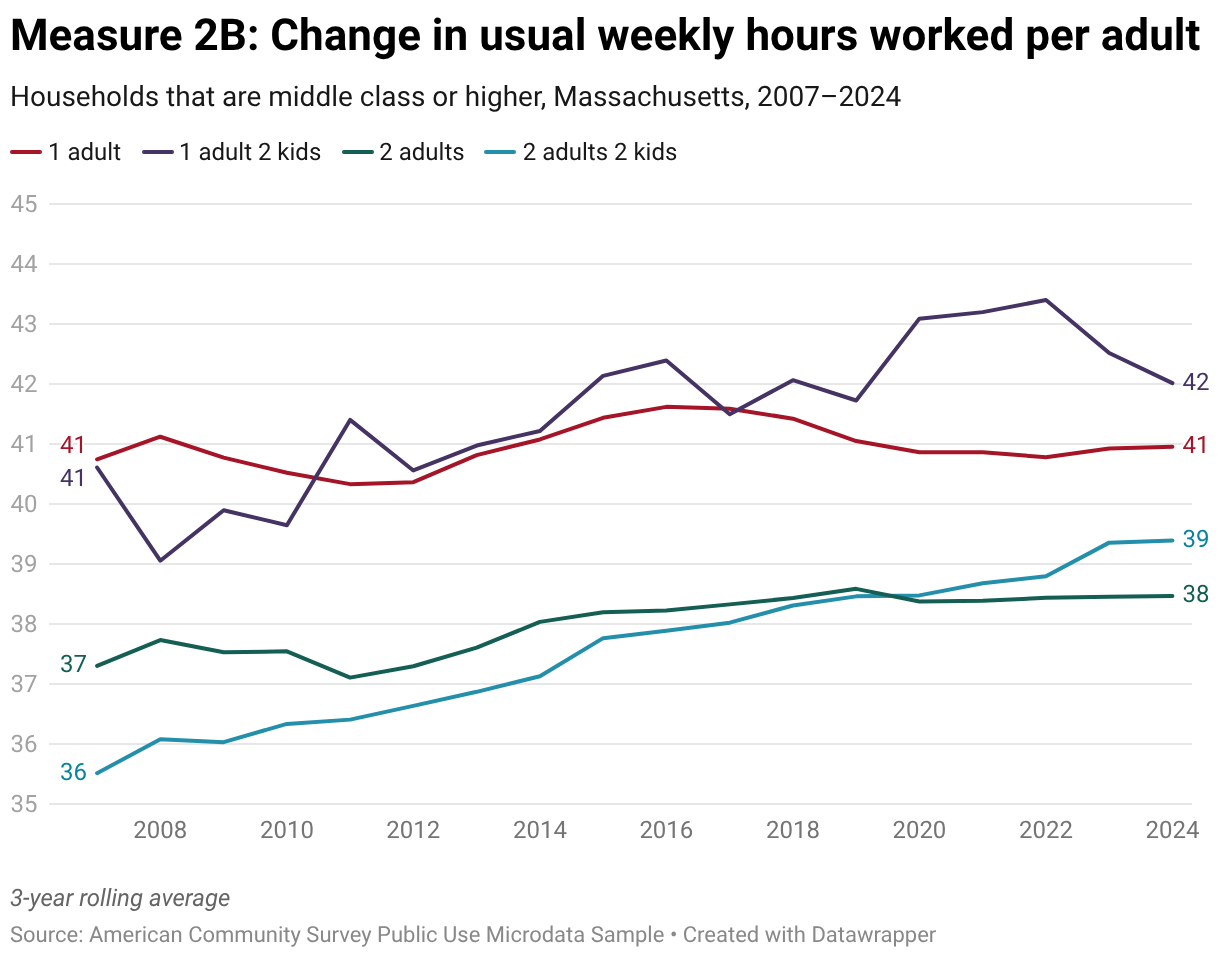
In 2024, adults in Massachusetts households that reached a middle-class standard of living worked substantially more paid hours, on average, than adults in households below the middle-class threshold. This gap should not be interpreted as simply a difference in effort. Households below the threshold include many people who face barriers to full-time employment, including disability, difficulty finding sufficient work hours, or limited access to well-paying jobs. The more important finding is the level of paid work associated with reaching the middle-class: Across benchmark types, households above the middle-class threshold averaged about 38 to 43 hours of paid work per adult per week. In practice, this suggests that middle-class status in Massachusetts often depends on all working-age adults in the household being able to sustain full-time employment. The pressure is especially acute for single parents, who report the highest work hours, averaging about 43 hours per adult per week in 2024.

Over the past two decades, average paid work hours have been remarkably stable for middle-class households without children. Single adults with no children have consistently worked close to 41 hours per week, and two-adult households without children have hovered near 37 to 38 hours, with year-to-year movement largely within the margin of error. The clear exception is two-adult households with two children, where average hours per adult rose from about 36 in the 2005 to 2007 period to roughly 39 in the 2022 to 2024 period—an increase well above the margin of error for the estimate.
This growth in average hours worked among middle-class households with two adults and children is driven by an increase in both parents working full-time. In 2007, households with children were less likely to have both adults in the labor force: About 70 percent of two-adult households with two children were dual-earner, compared with 77 percent of two-adult households without children. From 2007 to 2024, the share of dual-earner households grew in both groups, but the increase was substantially larger among households with children. By 2024, the share of dual-earner two-adult, two-child households had not only caught up to households without children but surpassed them—roughly 88 percent of households with children versus 84 percent of households without children. This trend continues a long-running finding from MassINC’s middle-class research: Households, and especially those raising children, have increasingly relied on two earners to maintain middle-class living standards.

While middle-class households are working more, they are also earning more. Among two-adult, two-child households at or above the middle-class threshold, inflation-adjusted household income rose by about 22 percent over the past two decades. The question is what produced this gain: Were these families getting more income without adding much more work, or did higher income depend on putting in more total household hours? The answer is both.1

More household work hours accounted for 11.4 percentage points of real household income growth, or about half the total increase. The remaining 11.0 percentage points came from income growth not explained by added hours—a category that may include higher real hourly earnings, bonuses or self-employment income, investment returns, transfers, or other non-labor income. In other words, middle-class families with children gained ground through a combination of more work and some undetermined combination of higher compensation and non-labor income—not through either factor alone.
The pattern looks very different for two-adult, two-child households below the middle-class threshold, whose income grew much more modestly—and almost entirely because they worked more hours. Real household income rose by just 5.6 percent over the past two decades, and 5.2 percentage points of that increase, or more than 90 percent, came from additional household work hours. Income growth not explained by increased hours contributed only 0.3 percentage points for this group.

This distinction matters because income growth can look stronger on paper than it feels in real life. When income rises partly because households are working more hours, the gain comes with a tradeoff: fewer hours left for caregiving, rest, household management, civic participation, and other parts of family and community life. Additional work hours can also create new expenses—from childcare and after-school programs to prepared meals and other time-saving purchases—meaning that some of the added income is spent just making more work possible.
3. Travel and Commuting
Commuting adds another layer to the time demands associated with reaching a middle-class standard of living. Across each benchmark household type, households at or above the middle-class threshold report longer average commute times than households below the threshold. The differences are modest, but consistent: about 30 minutes versus 28 minutes for single adults, 35 minutes versus 28 minutes for single parents, 32 minutes versus 29 minutes for two-adult households without children, and 36 minutes versus 31 minutes for two-adult households with two children.
These differences reinforce a broader pattern in the time-use analysis: Reaching the middle class often comes with a time tax. Households that make it to the middle-class threshold tend to work more paid hours, and they may also spend somewhat more time getting to and from work. In that sense, it costs time to make money: Higher income may require access to better-paying jobs that are farther from home. However, these data measure the length of the commute on days workers travel to work, not how many days per week they commute. As a result, they may overstate the weekly commuting burden for workers with hybrid schedules, especially in higher-paying occupations where remote work is more common.
For two-adult households, the commute burden may be especially complicated because families are often solving for two job locations rather than one. This “two-commute” problem can be particularly difficult for households with children, who may also be balancing housing costs, school district preferences, childcare logistics, and other family needs.

Average commute times rose across the benchmark household types through the 2010s, peaking around 2018 or 2019 before falling during the pandemic period. By 2023, commute times were below their pre-pandemic highs for single adults, two-adult households, and two-adult households with two children. In 2024, however, commute times rose again. Two-adult, two-child households reported an average one-way commute of about 36 minutes in 2024, significantly higher than the 32-minute average two decades prior.

These trends are difficult to interpret because the pandemic changed who commutes and how often they commute in ways that the ACS data on one-way commutes do not capture. The post-2019 decline likely reflects the rise of remote and hybrid work, while the 2024 increase may reflect more workers returning to the office.
4. Volunteering and Civic Life
The importance of the middle class has never been understood in purely economic terms. It has also mattered because of what middle-class security makes possible: enough time, stability, and autonomy to participate in family, community, and civic life. This makes the increasing time squeeze facing two-adult households with children more than a private problem: When paid work and caregiving consume more of the week, households may have less capacity for the civic activities that help communities function and give residents collective voice.
Because the CPS Volunteer Supplement sample is too small to support the full middle-class benchmark household specification, this section focuses on all non-retired households under age 65 and compares volunteering by average paid work hours per adult per week and whether the household includes children. The results are descriptive, but they help show how paid work, family responsibilities, and civic participation intersect in household life.

The most recent CPS Volunteer Supplement surveys were administered in 2021 and 2023. We pooled these two waves to increase sample size. The combined data show volunteering was lowest among households with fewer average paid work hours. Among households without children, 22 percent of those averaging less than 25 paid work hours per adult volunteered, compared with 33 percent of those averaging 25 hours or more. Among households with children, the pattern was stronger: 21 percent of those averaging below 25 hours per adult volunteered, rising to 54 percent among those averaging 25 to 34 hours. However, volunteering then fell to 43 percent among households with children averaging 35 or more hours per adult—a sign that heavier paid-work schedules may be crowding out volunteering and civic participation. This suggests that the proclivity to engage in paid work is correlated with the proclivity to engage in unpaid work, but when all adults in a household are working full time or more, the combined demands of paid work and caregiving may limit the time available to volunteer.

Volunteer hours have fallen sharply in Massachusetts, mirroring a broader national decline. Among non-retired households under age 65, average annual volunteer hours in Massachusetts fell from about 49 hours per household in the period from 2006 to 2010 to 25 hours in the period from 2021 to 2023. Nationally, the same measure fell from about 57 hours to 26 hours over the same period. Massachusetts households volunteered fewer hours than the national average throughout the period, but the gap narrowed substantially as national volunteer hours declined more steeply.
This decline does not prove that longer work hours directly caused the drop in volunteering. But it is consistent with the broader time-budget story: As paid work has become more central to maintaining a middle-class standard of living, households appear to have less time left for unpaid civic participation.
- The decomposition analysis separates CPI-adjusted household income growth into the portion associated with increased total household work hours and the portion associated with higher implied income per hour. Because income reflects both factors, the contribution of each depends on which is assumed to change first. We use a Shapley-style decomposition, which averages across both orderings, so the interaction effect is not arbitrarily assigned to either component. ↩︎
The Massachusetts Middle Class Status Report
Chapters
Introducing the Massachusetts Middle Class Status Report
Component 1: The Middle-Class Budget by Household Type
Component 2: Who Can Afford a Middle Class Lifestyle
Component 3: The Middle-Class Time Budget and Civic Participation
Component 4: Financial Security
Component 5: Economic Mobility and the Geography of the Middle Class

The Massachusetts Middle Class Status Report
January 28, 2026