The middle class has long stood at the center of America’s economic story and civic imagination. A healthy middle class validates a promise that effort and contribution will yield stability and opportunity. For policymakers, business leaders, and families alike, the status of the middle class serves as a barometer to gauge whether economic progress is generating broadly shared economic opportunity and prosperity.
Three decades after MassINC first placed the condition of the middle class at the heart of its founding mission, this core focus feels newly urgent. Across the commonwealth and the nation, concerns about affordability, economic mobility, and financial security dominate public debate. There is widespread uncertainty about whether the traditional pathways to middle-class life remain open, and whether policymakers have made the right choices on behalf of a broad swath of Americans.
A healthy middle class validates a promise that effort and contribution will yield stability and opportunity.
Assessing the economic foundations of contemporary middle-class anxiety is difficult. In part, this is because we lack a consistent definition. Used variously to describe income, education, occupation, or lifestyle, the term “middle class” often resists precise measurement, and conventional metrics can obscure as much as they reveal.
The Massachusetts Middle Class Status Report begins with the premise that to monitor the health of our commonwealth, we must track the health of our middle class—not as a static income group, but as a financial position that can only be understood in relation to the costs of participation in contemporary society: What kind of income and effort are required today for ordinary households to build stable, self-directed lives?
This introductory essay establishes the foundation for a layered analysis of middle-class economic life in Massachusetts by tracing the historical meaning of the term middle class, revisiting findings from previous MassINC research on the state of the middle class, and describing new methods that the Status Report will employ to gauge the health of of the Massachusetts’s middle class today.
The History of the Middle-Class Construct
The idea of a middle class is older than the term itself. In Politics, Aristotle described a well-ordered polity as one sustained by “those in the middle” (the hoi mesoi)—citizens neither rich enough to subjugate others nor poor enough to be subjugated themselves.1In this group, he saw the foundation of equity and civic balance: a citizenry capable of both exercising individual freedom and acting responsibly on behalf of the collective good. The middle stratum was thus defined less by consumption or wealth than by the material independence believed to enable responsible participation in public life.
The actual term “middle class” emerged much later, shaped by the social and economic transformations of early modern Europe. The phrase is purported to have first appeared in James Bradshaw’s 1745 pamphlet, Scheme to Prevent Running Irish Wools to France. Bradshaw used this wording to refer to merchants and professionals who occupied the space between landed aristocracy and manual labor. Related terms such as bourgeoisie emerged to describe a diverse group—ranging from small traders and artisans to lawyers, industrialists, and factory owners—united less by income than by the combination of work, property holdings, and education.
In the nineteenth century, social theorists in Britain, France, and Germany began to analyze this group more explicitly, treating the bourgeoisie as a distinct social class with a formative role in modern society.2 Many analysts saw this group as central to the development of markets, institutions, and civic life, crediting it with strengthening the public sphere and sustaining both economic progress and social order. The modern statistical use of “middle class” followed later, most notably with T.H.C. Stevenson’s 1913 registrar-general’s report, which formally placed the middle class between the upper and working classes within the UK’s social hierarchy.3

When these ideas reached the United States, they developed with a stronger emphasis on economic position than on social standing. Lacking an inherited nobility, early Americans saw the “middling” condition as a reflection of civic equality—a society built not on birth but on effort, participation, and fairness. Alexis de Tocqueville admired the extraordinary openness of American life—the fluidity that allowed ordinary citizens to rise through enterprise and talent—but he also emphasized the importance of civic intermediaries to channel that energy toward the common good. In his view, local institutions, voluntary associations, and habits of self-governance were essential to prevent democratic equality from devolving into isolation, privatization, and dependence.
For much of American history, these civic networks were robust—what Robert Putnam later described as a culture rich in “social capital,” where community organizations, clubs, and local associations knit individuals into a shared public life. As a result, the “middling” condition came to signify not only economic stability but civic capacity—shaped through schools, associations, workplaces, and local institutions that cultivated shared norms of responsibility, participation, and belonging as essential complements to material independence.
This ideal found its clearest early expression in the American Dream as a social construct, articulated during a period of profound economic and political uncertainty. Writing in 1931, amid the Great Depression, historian James Truslow Adams defined the American Dream as “a social order in which each man and each woman shall be able to attain to the fullest stature of which they are innately capable.”4Adams’s emphasis on a social order was deliberate. He did not describe success as the outcome of individual striving alone, but as something made possible—or impossible—by the structures of civic and economic life.
Writing in 1931, amid the Great Depression, historian James Truslow Adams defined the American Dream as “a social order in which each man and each woman shall be able to attain to the fullest stature of which they are innately capable.”
At the same time, the promise embedded in this ideal was never evenly realized. Throughout history, access to the material independence and institutional support associated with middle-class life was systematically denied to many based on country of origin, race, gender, and other ascribed characteristics. Accordingly, large segments of the population did not see the American Dream as a proposition that applied to them, with intergenerational consequences that continue to shape opportunity today.

In the decades following World War II, the American Dream was reinterpreted in the material frenzy of the post-World War II period, when it took on an increasingly individualistic and consumer-oriented cast—symbolized by homeownership, rising consumption, and private mobility. These portrayals of American ideals were often detached from the collective arrangements and mutual responsibility that had made broad-based opportunity possible in the first place.5Yet, the notion that each generation can do successively better than the last by working hard and playing by the rules persisted.
In this sense, the middle class has always been more than an income bracket. It represents the expectation that individual aspiration and collective responsibility advance together. The question facing any democracy, and the one at the center of the Status Report, is how well this balance holds: whether opportunity remains broad enough, public life accessible enough, and economic security attainable enough for the middle class to continue serving as democracy’s stabilizing force.
Building on the Contributions of Previous MassINC Research
In the spirit of the civic intermediaries that de Tocqueville saw as essential to a healthy democracy, the Massachusetts Institute for a New Commonwealth (MassINC) entered public life with a commitment to nurture the growth and vitality of the middle class through nonpartisan research, journalism, and civic events. The goal was to foster public discourse grounded in objective evidence. While separate and distinct, each division of the organization has sought to build a shared fact base from which policymakers, business leaders, and civic actors with different values could reason together.
The MassINC Policy Center’s early work on the middle class focused on documenting changes in income, work, and economic security using the best available data and methods of the time. Our first foray into this research topic unfolded against a long period of weakening income growth and rising inequality. Nationally, real median family incomes began to stagnate in the early 1970s. By the late 1980s, income growth had become increasingly uneven, with gains concentrated at the top of the distribution while middle-income families saw little improvement. These trends are what motivated our founders to create MassINC in the first place.
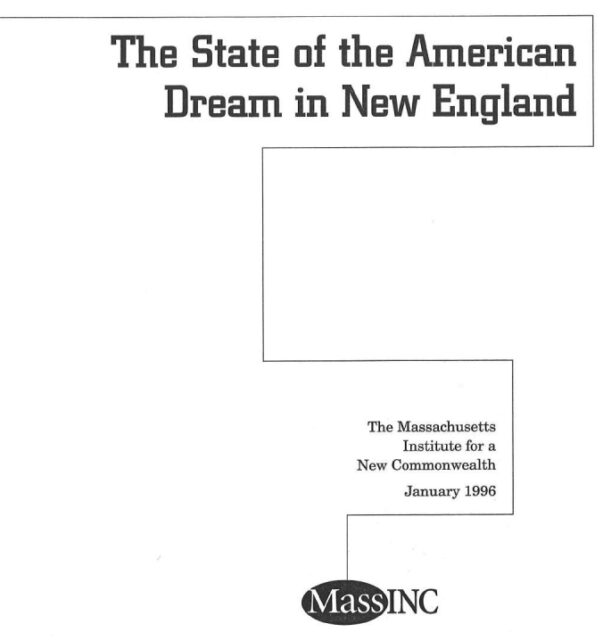
MassINC’s first major report, The State of the American Dream in New England (1996), documented how these national trends were playing out in the region. Defining the middle class as families in the middle 60 percent of the income distribution—a pragmatic choice given data limitations at that time—the report found that real median family incomes fell by about 5 percent nationally and 9 percent in New England between 1989 and 1994. Notably, residents at all education levels saw their incomes fall in this period. The report highlighted the emergence of a key adaptive strategy: Households increasingly relied on two earners to offset falling real wages and maintain middle-class living standards. The authors underscored that this shift largely reflected structural pressure rather than changing preferences or expanded opportunities.
Subsequent analyses in Unprecedented Prosperity? (2000) and The State of the American Dream in Massachusetts (2002) showed that the economic expansion of the late-1990s produced only modest gains for the middle. Median household incomes recovered slowly from the early-1990s recession, essentially returning only to late 1980s levels. Mean incomes rose more rapidly than the median, indicating that income growth was increasingly concentrated among higher-earning households. During this period, the share of total income accruing to middle-income families declined, and income inequality widened further in Massachusetts and the Northeast.
By the early 2000s, MassINC’s research concluded that the strategies families had used to sustain middle-class status—longer hours, dual earners, and higher educational attainment—were no longer sufficient to reliably maintain middle-class progress. The State of the American Dream in Massachusetts (2002) documented extraordinarily high work hours among middle-income families, yet diminishing returns for that work. The analysis also recorded how difficult it had become for single-earner households to achieve middle-class status, at precisely the same time that more and more households were headed by a single individual.
This theme surfaced even more strongly in Recapturing the American Dream (2011), which examined the “Lost Decade” from 2000 to 2010. During that period, labor productivity in Massachusetts grew by more than 17 percent, while mean weekly wages rose by just 0.1 percent, signaling a pronounced decoupling of productivity and pay. Median household incomes declined, and income inequality continued to widen.
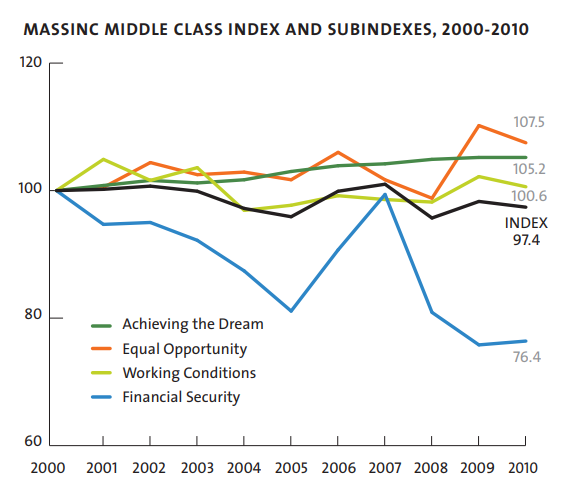
A final and increasingly important dimension of middle-class vulnerability is rising income volatility. Even where average incomes have held steady, year-to-year earnings have become markedly less predictable, making it harder for families to reduce debt, save for retirement, or follow long-term financial plans. MassINC’s Middle Class Index (2011) documented a sharp decline in financial security between 2000 and 2010, driven not only by weak income growth but by increasing income volatility alongside rising costs for education, healthcare, and housing. Income volatility in Massachusetts had increased by nearly one-third since the early-1990s, mirroring national trends, and notably peaked in 2006—during a period of economic expansion rather than recession.
To inform the discourse around how Massachusetts responds to the structural economic conditions reducing upward economic mobility, MassINC research has branched out into a universe of interrelated issues and systems—education, housing, transportation, and workforce development. Our research has also sought to emphasize the importance of place-based efforts, with a particular focus on Massachusetts’s Gateway Cities, regional urban centers where many generations of Massachusetts families begin their climb into the ranks of the middle class. These topics have increased our understanding of how state and local government in Massachusetts can respond to the macrolevel forces placing pressure on upward economic mobility and family financial security.
Since MassINC’s last comprehensive assessment of the middle class in 2011, both the economy and the data environment have changed substantially. Many of the core indicators used in earlier reports—median income, labor market participation, and selected household features—are now readily accessible online to researchers, advocates, and policymakers with basic proficiency in U.S. Census data. What has been missing is not attention to these trends, but a renewed effort to take advantage of improved data availability and analytical capacity to measure the middle class more directly and comprehensively. This project seizes on this opportunity to revisit the state of the middle class with tools that allow a more precise and empirically grounded assessment of economic and civic life.
Leveraging Big Data to Improve Our Understanding of the Middle Class
As MassINC approaches its 30th anniversary, the concerns that motivated its founding have moved decisively into the center of public life. Questions of housing affordability, cost-of-living, and the fragility of the middle class now dominate political discourse across the ideological spectrum. Even when economic indicators suggest progress, public perception indicates broad skepticism and frustration, especially among younger adults.
This analysis aims to tease out the disconnect in as much detail as possible. To do so, it adopts a framework centered on economic participation costs and disposable income and built on the premise that the middle class is not a statistical artifact, but a social condition defined by autonomy and security—the ability to get ahead in life and participate fully in society.
Even when economic indicators suggest progress, public perception indicates broad skepticism and frustration, especially among younger adults.
Coupling the large volumes of government data that are now readily available with advanced computational methods that allow us to process this trove of information faster, we aim to shed new light on how economic forces are impacting different types of households in the commonwealth. The Middle-Class Status Report will present this information in five core components:
- Component 1: The Middle-Class Budget by Household Type
The foundation for the analysis is budgeting the cost of a middle-class lifestyle using a residual-income framework. Rather than asking what households need to survive, this section estimates the income required to meet the participation costs embedded in contemporary economic life—housing, healthcare, childcare, transportation, food, education, taxes, and other baseline necessities. Costs are modeled by age and household type to reflect shifting financial responsibilities over the life course. - Component 2: Who Can Afford a Middle-Class Lifestyle
Employing our middle-class budget assumptions as a yardstick, we estimate the size of the middle class in Massachusetts. This component will also include analysis of how middle-class affordability intersects with occupations according to their perceived levels of prestige, drawing the lines between social status and economic sufficiency. - Component 3: Work, Leisure Time, and Civic Engagement
To assess whether economic sufficiency in the commonwealth is accompanied by adequate time for rest, family responsibilities, and engagement in community-serving and civic institutions, we examine trends in hours worked, commute times, and volunteering rates. - Component 4: Economic Security
To determine whether households with middle-class earnings can sustain this position over time, or whether insecurity remains a pressing concern, we analyze income volatility, bankruptcy filings, exposure to health-care costs, and financial assets. - Component 5: Economic Mobility and the Geography of the Middle Class
Finally, we gauge changes in economic mobility through measures of income inequality, educational attainment, business ownership, and homeownership. This component also charts changes in concentrated poverty and income segregation to provide an indication of whether the commonwealth’s economic geography is shifting in ways that open or close access to opportunity.
Taken together, the data and analysis presented within these five core components of the Status Report will provide a clear, empirically grounded account of middle-class economic reality in Massachusetts today. Where sufficient data is available, the Status Report will also track the commonwealth’s changing performance relative to other states over time.
Much like the Gateway Cities Housing Monitor, MassINC’s research team plans to refine and update this analysis annually. The components of the Status Report will be issued one-by-one over the coming weeks leading up to MassINC’s anniversary celebration in May. In the meantime, we encourage readers to dig back into our report archives for more on how the middle class has been reshaped by changing economic tides.
- Aristotle, Politics, trans. H. Rackham (Cambridge, MA: Harvard University Press, 1932), 1295b35–39. ↩︎
- Jürgen Habermas, The Structural Transformation of the Public Sphere: An Inquiry into a Category of Bourgeois Society, trans. Thomas Burger with Frederick Lawrence (Cambridge, MA: MIT Press, 1989). ↩︎
- T.H.C. Stevenson, Report of the Registrar-General on the Population, England and Wales, 1911: Classification of Occupations (London: HMSO, 1913). ↩︎
- Adams, James Truslow. The Epic of America. Boston: Little, Brown, and Company, 1931. ↩︎
- Cohen, Lizabeth. A Consumers’ Republic: The Politics of Mass Consumption in Postwar America. New York: Alfred A. Knopf, 2003. ↩︎
The Middle Class Status Report
Chapters
Introducing the Massachusetts Middle Class Status Report
Component 1: The Middle-Class Budget by Household Type
Component 2: Who Can Afford a Middle Class Lifestyle
Component 3: The Middle-Class Time Budget and Civic Participation
Component 4: Financial Security
Component 5: Economic Mobility and the Geography of the Middle Class
The Massachusetts Middle Class Status Report
January 28, 2026