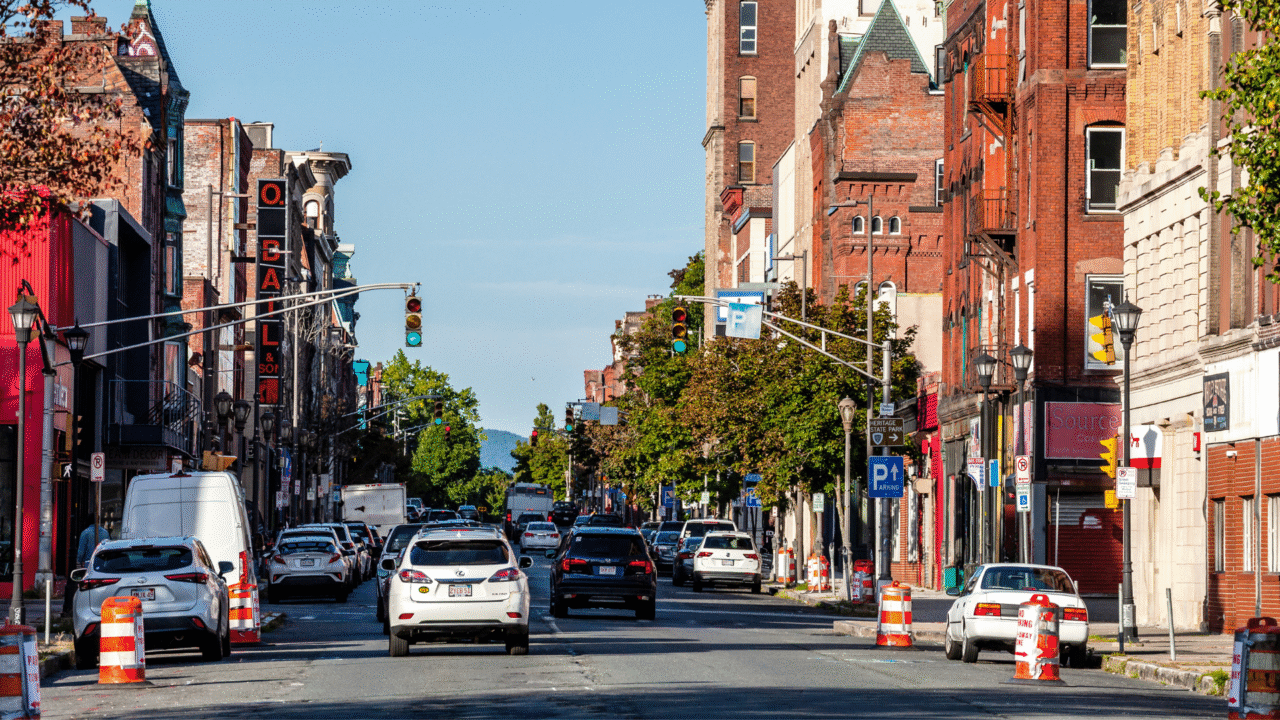
Our beleaguered local business districts are getting a little love in time for Valentine’s Day. The administration recently created a new program called MDI Capital to help replace the Massachusetts Downtown Initiative (MDI), which lost funding last year. Communities may apply to MDI Capital as part of the Community One Stop for Growth portal. FY 2027 applications opened last month and communities have until June to submit their full proposals.
Eligible activities include planning grants of up to $100,000 for:
- Downtown/Village center improvement plans; and
- District management creation.
Implementation grants up to $250,000 are available for:
- Public realm and streetscape improvements;
- Wayfinding and signage improvements; and
- Public facilities and gathering spaces improvements.
Although it is still not clear how much will be expended in FY 2027, the funding will come from the capital budget rather than the operating budget. In 2024, the state legislature, led by the Gateway Cities caucus, won approval of a $9.5 million authorization for downtown vitality efforts in the economic development bond bill. After declining to tap these funds in the FY2026 capital budget, the Healey administration now appears poised to appropriate some of them to support this new program.
Agency officials at the Executive Office of Economic Development (EOED) indicated that the total amount appropriated will depend on the administration’s capital budgeting process, as well as the demand demonstrated for the program through expressions of interest.
EOED anticipates the new program could fully replace the old MDI technical assistance program, which had been funded in the state’s annual operating budget at $600,000 per year. However, capital funds may have restrictions that operating funds do not; for example, there may be reluctance to use these dollars for reoccurring grants to sustain local economic partnerships, such as cultural districts or business improvement districts (BIDs).
At last year’s Gateway Cities Innovation Summit, MassINC presented former MDI program manager Emmy Hahn with a Gateway Cities Champion Award for her career supporting and coaching local downtowns. The standing ovation she received indicated just how valuable this kind of state partnership can be for local communities.
MDI Capital has the potential to increase the state’s much-needed investment in downtowns and main streets if the administration leverages the full authorization and appropriates at least $3 million each year for the program. But we still need to address the operating gap for local downtown partnerships, as described in our District Management for Downtown Vitality study, and address the capacity in-house at EOED to provide ongoing informal technical assistance. MDI Capital is an excellent step forward, but Massachusetts must continue to steer toward a stronger vision for local economic development, one grounded in real places, and supported by real love from the state.
Get the latest updates on policy issues impacting Gateways Cities delivered right to your inbox.
The Gateway Cities Innovation Institute strengthens connections across communities and helps Gateway City leaders advance a shared policy agenda.