
Ben Forman is the Director of MassINC’s Policy Center. He coordinates the development of the organization’s research agenda and oversees production of research reports. Ben has authored a number of MassINC publications and he speaks frequently to organizations and media across Massachusetts. With a background in urban revitalization and sustainable growth and development, he is uniquely suited to the organization’s focus on strong communities and economic security.
Prior to joining MassINC in 2008, Ben oversaw strategic planning for the District of Columbia Department of Parks and Recreation, a large agency providing critical services to youth and families in neighborhoods throughout the city. He also worked as a research assistant at the Brookings Institution Metropolitan Policy Program in Washington, DC and Nathan Associates, a global economic development consulting firm.
As a graduate student, Ben was awarded a Rappaport Public Policy Fellowship and served in the City of New Bedford’s planning department. He also worked as a graduate research assistant on a multi-year longitudinal analysis measuring the impact of new information technologies on neighborhood social networks.
Ben graduated from Trinity College, Hartford with a bachelor’s degree in economics. He completed his master’s degree in city planning at the Massachusetts Institute of Technology.
-

Gateway Cities Journal — Gateway Cities
Gateway Cities Journal | Summer in the City
Summer in the Gateway Cities bursts with cultural festivals and community gatherings that not only celebrate local pride and diversity, but also fuel small business growth and economic resilience.
August 8, 2025
-
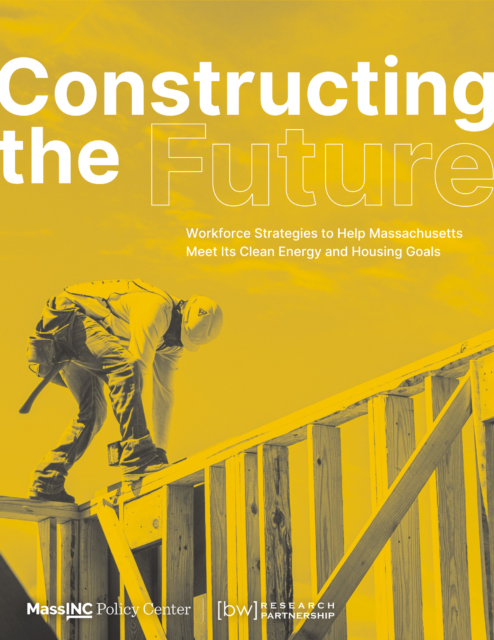
Constructing the Future: Strategies to Help Massachusetts Meet Its Clean Energy and Housing Goals
June 17, 2025
- Construction output has declined in recent years. Prompt action to stimulate demand is necessary to sustain this critical workforce and preserve long-term industry capacity.
- Assuming continued economic growth, scaling up the training system to meet workforce needs for housing and clean energy should be an attainable goal.
- Recent progress in racial, ethnic, and gender diversity presents an opportunity to expand the industry’s future labor pool.
- Reducing construction costs while maintaining competitive, family-sustaining wages will require meaningful gains in productivity.
-
Gateway Cities Journal — Gateway Cities
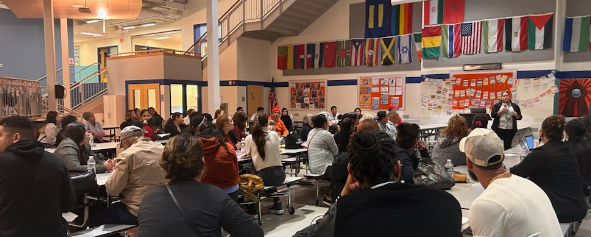
Gateway Cities Journal | ESOL in Massachusetts: Short-term relief, long-term strategy
Progress in the quest for a more robust and more dynamic ESOL training system in Massachusetts.
May 15, 2025
-
Public Commentary — Policy Center
Kerry Healey was right: we should discuss senior ‘overhousing’
Making it easier for seniors to downsize would be welcomed by those who want to move — and be a boon for families squeezed by our housing shortage.
April 2, 2025
-
Reckoning with Historic Unfunded Municipal Pension Obligations
This report examines the historical decisions that contributed to these unfunded liabilities and highlights how current taxpayers are paying more than their fair share.
March 25, 2025
- As of 2023, recent generations of Massachusetts taxpayers paid an estimated $22 billion more than their fair share to cover local pension obligations left by prior generations, yet these local plans still have an estimated $8 billion in unfunded liabilities.
- Current taxpayers face additional costs because most of the pension funds are managed by local boards that have underperformed the state pension fund by more than $5.4 billion since the 1980s.
- Geographic disparities associated with uneven changes in population since the late 1970s have exacerbated this burden for residents of some communities, including many Gateway Cities.
- This pattern means lower-income residents and people of color shoulder an inequitable share of legacy pension costs. Since the 1980s, Gateway City residents have paid billions more than their own generation’s fair share to cover local pension costs, with more than $5 billion in appropriations made for legacy pension costs since 2010.
-
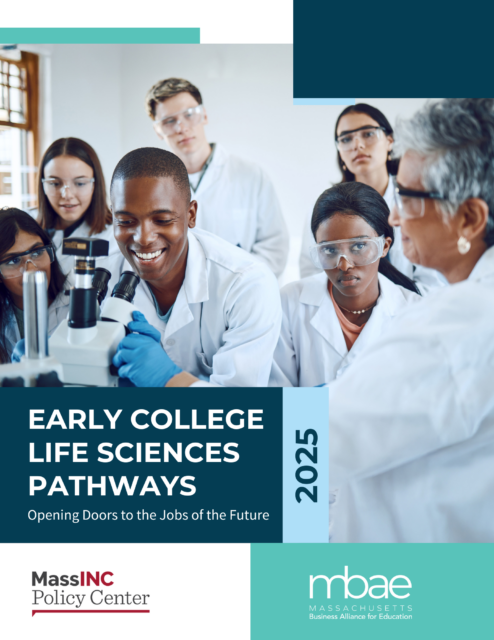
Early College Life Sciences Pathways
Expanding Early College access and strengthening career-connected learning are critical to ensuring Massachusetts maintains a competitive, skilled workforce. This report outlines four key objectives to guide an expansion strategy that state leaders are currently developing.
March 3, 2025
- Early college is Massachusetts’ most systemic and impactful effort to increase college access and success. Marrying this educational equity strategy with industry-led efforts to grow the life sciences workforce will deliver stronger results on both fronts.
- Building robust Early College life sciences pathways is a difficult and complex undertaking that requires strong industry involvement. At present, the industry has very little awareness of the state’s Early College strategy, and there has been no formal effort to engage the sector in the state’s ambitious Early College initiative.
- With the Massachusetts Early College Initiative conducting its first strategic plan and the state’s Life Sciences 3.0 economic development package signed into law, the coming months will be decisive. The actions leaders take to enable the growth of Early College life sciences pathways will heavily influence the ability of Massachusetts students to participate fully in this cutting-edge industry for years to come.
-
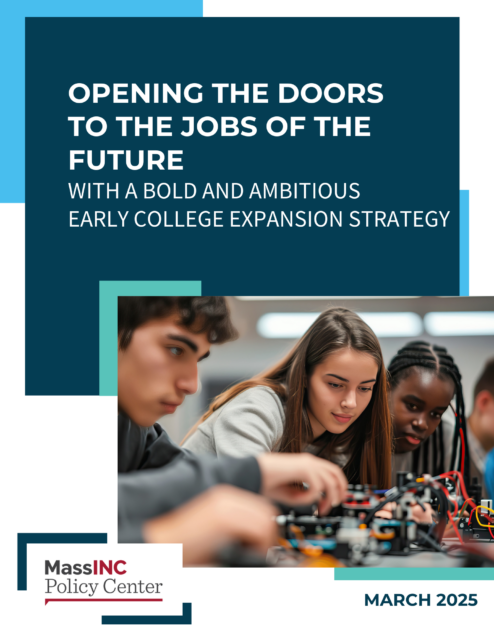
Opening the Doors to the Jobs of the Future
Expanding Early College access and strengthening career-connected learning are critical to ensuring Massachusetts maintains a competitive, skilled workforce, and this report outlines four key objectives to guide the state's expansion strategy.
March 3, 2025
- Massachusetts must significantly expand Early College programs to reach more low-income students, as current enrollment remains too limited to make a substantial impact. The state should prioritize high-potential high schools and utilize hybrid or online learning models to ensure accessibility, particularly for students in rural areas.
- Current Early College programs lack structured connections to high-demand industries like health and STEM. A more robust program should integrate specialized advising, career development experiences, and credit accumulation targets, while also aligning Early College with Innovation and Career Pathway (ICP) programs.
- Expanding Early College to middle-income students can create more diverse learning environments, strengthen urban schools, and support high school redesign in smaller districts. Targeted strategies include regional partnerships, urban magnet schools, and enrollment goals that promote integration in Boston and the Gateway Cities.
- Sustainable Early College expansion will require clear governance structures, accountability measures, and administrative capacity. Some necessary policy changes will need to be addressed through board decisions, legislation, and budget appropriations.
-
2024 Gateway Cities Housing Monitor
To recover from an affordable housing crisis that has been decades in the making, Massachusetts needs Gateway City housing markets to produce new homes in line with increasing demand.
November 14, 2024
- Over the next ten years, Gateway Cities should aim for the creation of 83,000 additional housing units.
- Meeting the housing production goal requires doubling the pace of housing production compared to the previous 10 years.
- Increasing housing production will require robust state and local partnerships to overcome financial and regulatory barriers.