Executive Summary
Employer demand far exceeds the supply of workers in six key nursing and allied health fields. Education programs recognize this intense shortage, and the vast majority want to grow to help address it. However, a variety of barriers severely constrain their ability to add capacity. This has substantial and unsustainable consequences for the state’s leading industry, as well as for individual economic opportunity, upward mobility, and health and well-being.
Produced in partnership by the MassINC Policy Center, the Massachusetts Health and Hospital Association, the Massachusetts Association of Community Colleges, and the Richard and Susan Smith Family Foundation, this analysis provides an in-depth examination of these supply and demand imbalances, the barriers to expanding enrollment, the costs and consequences, and potential solutions.
Supply and Demand Imbalances
Surveys of acute care and long-term care employers, interviews with education providers, and analysis of publicly available workforce and education data surfaced five key signs and drivers of supply and demand imbalances in mission-critical nursing and allied health occupations:
- Certificate and degree completions have fallen considerably over the past decade. Compared to 2016, completions have fallen by 23 percent across the six programs, on average. Contraction has been sharpest for med lab techs (-46 percent), LPNs (-30 percent), and ADNs (-23 percent).
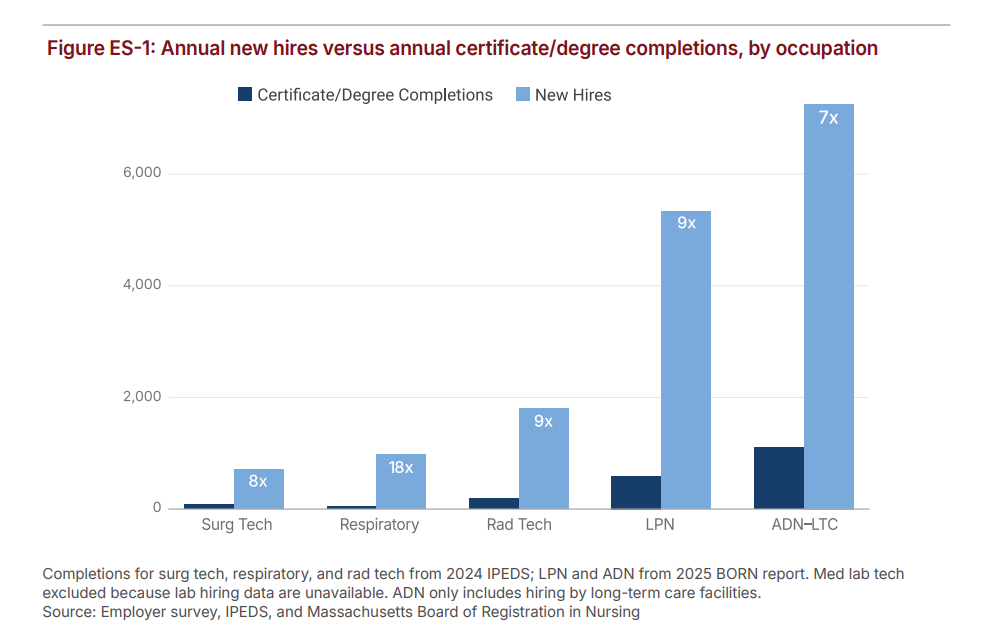
- Education programs in Massachusetts do not produce enough graduates to fill current vacancies, and their yield falls far short of total annual hiring needs. Facilities report that one in eight LPN positions are open; for rad tech and respiratory therapy, it is one in six. Education programs do not produce enough graduates to fill current vacancies in any of the six occupations. Across the six occupations, new hires exceed new graduates by a by ratios ranging from 7:1 to 18:1 (Figure ES-1).
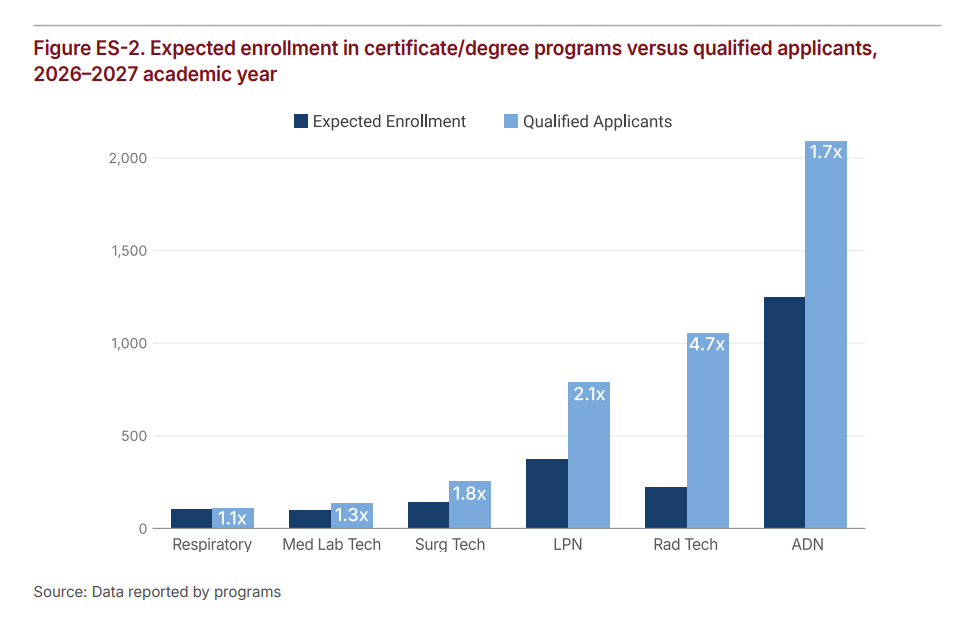
- The number of qualified students seeking education for these occupations from Massachusetts community colleges exceeds expected programmatic capacity by at least two to one. Community college programs for these six occupations currently draw about 4,500 applicants, but they only have the capacity to enroll around 2,200 students. The imbalance is most severe for rad tech, where programs have five qualified applicants for each available seat (Figure ES-2).
- While many programs are working to increase enrollment, planned expansion is far below the capacity required to meet current and future workforce needs. Across the six programs combined, planned expansion over the next two to three years is around 400 seats, or roughly 20 percent more than expected enrollment for the fall of 2026. If programs continue to grow at this pace through the end of the decade and completion rates hold steady, the gap between hires and graduates coming through these education pipelines will widen slightly. However, if growth in demand for health services accelerates in the coming years as expected, the gap between workforce demand and the state’s education pipeline will grow, and the pipeline will be able to provide less than 10 percent of the required workers by 2030.
- Large geographic gaps in education capacity exacerbate the workforce shortage in some parts of the state. Strikingly, education capacity in Greater Boston—the epicenter of the state’s global healthcare industry—consistently falls well below average based on its share of licensed beds.
Barriers to Expanding the Education Pipeline
While health deans and program leaders overwhelmingly want to expand enrollment further to serve qualified students and meet industry needs, large majorities identified three obstacles as a “top barriers” to expansion: insufficient clinical placements (85 percent), faculty and program leadership shortages (81 percent), and state regulatory barriers for nursing (74 percent).
The Costs and Consequences
The interview and survey data collected for this report reveal the costs of a narrow and severely constrained pipeline across multiple dimensions. In particular, three stand out:
- The high cost of staff turnover. In occupations facing severe labor shortages, persistent turnover creates a costly cycle that undermines the quality, accessibility, and affordability of care: Nearly one-fifth of surgical technicians left their positions over the past year; in long-term care facilities, more than a quarter of LPNs exited, and in acute care hospitals, turnover rates for ADNs were equally high.
- The high cost of travelers. Survey respondents for both acute and long-term care organizations reported a combined $232 million in annual spending on temporary agency staff. Extrapolating from these figures to all Massachusetts employers, the actual agency spend for these six occupations alone likely exceeds $450 million.
- The high cost of lost economic opportunity. Beyond the impact on healthcare organizations, these vacancies represent a missed economic opportunity for Massachusetts residents that is more difficult to quantify. However, we know that community college students who are unable to enroll in these programs often do not complete or fall back on other degrees that provide far less labor market benefit.
Potential Solutions
Our analysis shows that the scale of the mismatch between supply and demand in these six critical occupations is extremely large. Despite many well-intentioned efforts to meet these workforce needs, the gap is likely to widen in the future. Incremental improvement will not solve this problem.
To make real progress, the research points to four high-impact interventions that are within the span of control of Massachusetts educators, employers, regulators, administrators, and policymakers:
- Expand clinical education capacity by increasing the number, flexibility, and efficiency of clinical placements and clinical educators.
- Strengthen the educator workforce by addressing faculty compensation gaps and qualification constraints.
- Create a state regulatory environment supportive of expanding nurse education capacity and the associated increased flexibilities required.
- Develop longitudinal data systems to follow students through education, licensing, and into the workforce.
The findings of this analysis make clear that addressing these workforce shortages will require bold, coordinated action across healthcare, higher education, and state government. Strategic investments to expand educational capacity, strengthen clinical training opportunities, recruit and retain faculty, and remove barriers to program growth are essential to building a sustainable workforce pipeline. By acting now, Massachusetts has the opportunity to strengthen its healthcare workforce, improve access to high-quality care, expand economic opportunity for residents, and preserve the commonwealth’s position as a global leader in healthcare. The cost of inaction is simply too great—for patients, providers, communities, and the long-term health of the state’s economy.