Executive Summary
This brief offers guidance to cities stepping up to tackle the difficult work of School-Centered Neighborhood Development (SCND). With rising costs and growing economic segregation steadily eroding access to opportunity, these ambitious efforts to build more mixed-income neighborhoods and schools are absolutely essential to sustaining upward economic mobility in Massachusetts.
Fundamentally, this approach seeks to break down the silos between education, planning, housing, and community development. Backbone organizations are the key ingredient to this technically and politically challenging work. Their core functions include elevating resident voice and leadership, developing data-driven strategy, building cross-sector partnerships, and mobilizing resources.
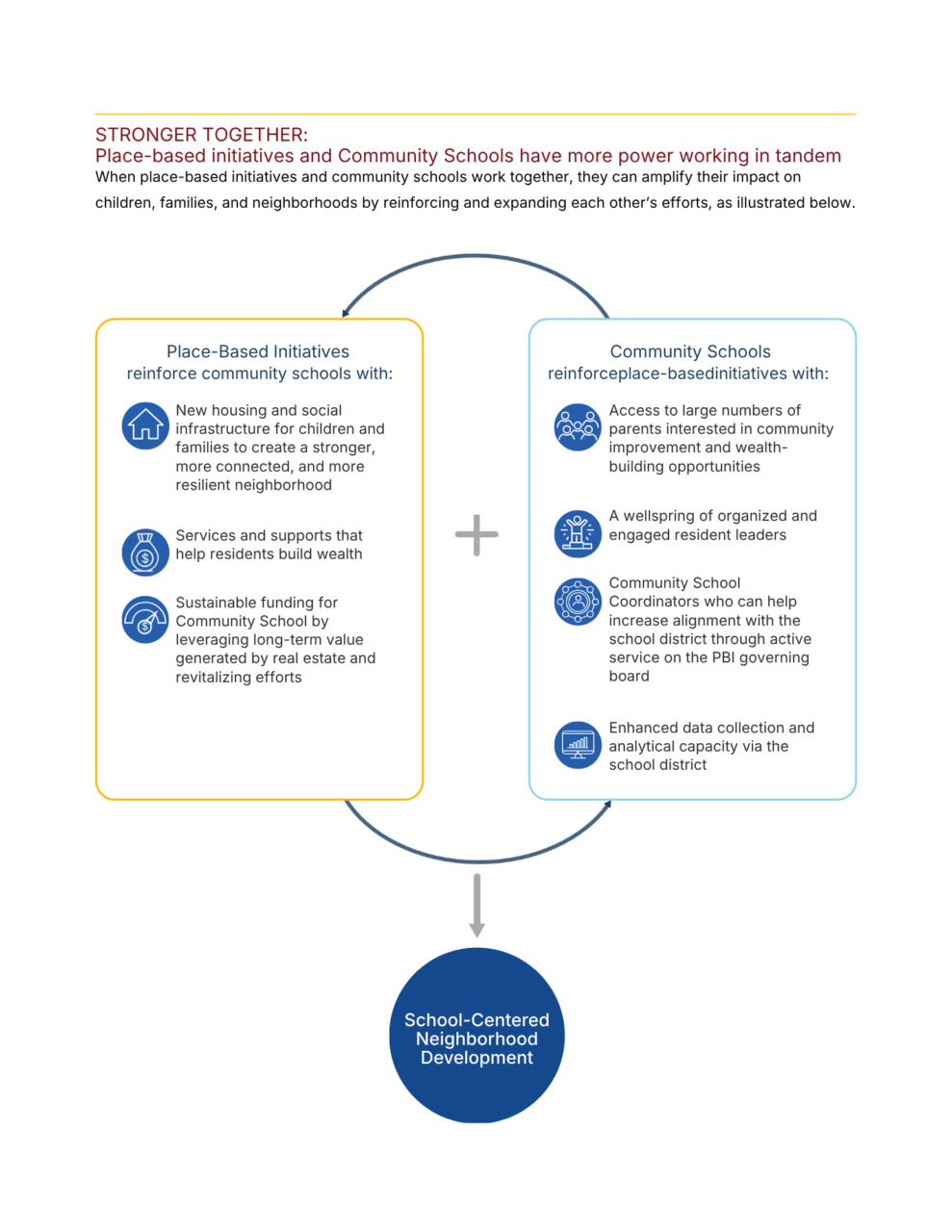
This analysis draws on a landscape scan of 10 established backbones across the US to better understand how these organizations operate. In particular, it homes in on linkages between place-based initiatives and Community Schools. When these closely related models work together, each can strengthen and extend the other’s efforts, amplifying their impact on neighborhoods that have suffered from decades of disinvestment.
As summarized below, this implementation brief provides guidance for cities seeking to build strong and sustainable backbone organizations to lead SCND initiatives across five foundational areas:
- Start-up. Simultaneously launching a place-based initiative and a Community School is a daunting proposition that could overwhelm any neighborhood. Several backbones in the landscape integrate these two approaches, but they reached this point through slow and steady evolution. Massachusetts cities laying the groundwork for SCND initiatives must think carefully about sequencing. Some already have Community Schools (or schools with many of the core capacities of Community Schools). Increasing parent and community leadership in these schools is a logical incremental step toward a more holistic SCND strategy, and the formation of a dedicated backbone organization to execute it. Other Massachusetts cities have major housing redevelopment projects underway that can provide a catalyst for launching an SCND backbone that will bring more resources and opportunities to the neighborhood over the long-term.
- Governance and strategic alignment. Backbone organizations must balance resource development with community ownership, while also ensuring strong alignment with local school systems. Most of the backbones in the scan recruit high-level business and civic leaders to create connections to resources. These well-respected leaders can also help ensure that governing board members prioritize the collective interests of the initiative to the greatest extent possible. Most of the initiatives in the scan lack school district leaders on their governing boards. In neighborhoods with Community Schools, the Community School Coordinator can provide executive level representation to help ensure strategic alignment with the neighborhood public schools.
- Core functions and staffing. Effective backbones require multidisciplinary teams with expertise in executive leadership, education, real estate, community engagement, fundraising, communications, and data and evaluation. Most backbones in the scan have in-house staff to cover several of these core capacities. To fill gaps, many draw support from local or regional partners or large national intermediaries, such as Purpose Built Communities and Strive Together.
- Sustainable financing. Backbones included in this scan typically launch with less than $500,000; over time, their operating budgets grow to between $2 million and $5 million annually. Most organizations creatively braid public and private capital to fund their place-based strategies. However, as these initiatives multiply and competition for limited state, federal, and philanthropic resources increases, they will need to find strategies to generate revenue from local real estate value creation. In Massachusetts, District Improvement Financing and other existing community development finance tools position cities to take this approach.
- Geographic scope and intermediary support. Most initiatives in the scan focus on relatively small areas (0.5 square mile to 1 square mile) to demonstrate commitment to the targeted strategy and to concentrate resources for impact. However, some organizations serve as backbones for place-based initiatives in multiple neighborhoods. Strong regional intermediaries can further expand this model by creating economies of scale, allowing neighborhood backbones to operate more efficiently while still accessing the full range of capabilities needed to be effective.